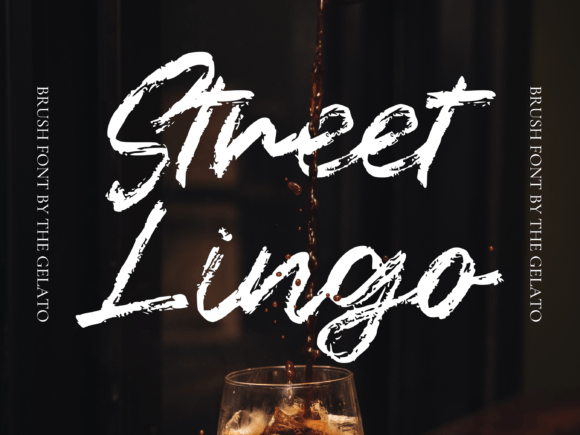
Street Lingo: A Bold, Smooth Display Font for Handmade Brands
If you've ever spent hours tweaking a label, re-cutting vinyl because the curves didn’t hold, or second-guessing whether your sticker font reads clearly at 1.5 inches — you know how much weight the right display font carries in handmade business. Street Lingo isn’t just another bold typeface. It’s the kind of font that lands with quiet confidence: bold enough to command attention on a market stall sign, smooth enough to cut cleanly on a Cricut or Silhouette, and distinctive enough that customers remember your brand after one glance at your candle jar tag.
What makes Street Lingo stand out is its balance — thick, generous strokes paired with soft, intentional curves. There’s no harsh geometry or aggressive angles here. Instead, it feels human-made: like chalk lettering refined into something polished but never sterile. That warmth translates directly to your products. A wedding welcome board in Street Lingo reads as joyful and grounded. A boutique clothing tag set in this font feels intentional, not trendy. And yes — it cuts beautifully. I tested it at 0.75" height on matte vinyl, and every curve held clean edges without feathering or bridging issues.
You’ll reach for Street Lingo most often when you need impact without shouting. Think: product names on apothecary-style labels (especially for candles, soaps, or small-batch teas), seasonal packaging like holiday cookie tins or summer lemonade mix jars, or even hand-lettered-style SVG files for sublimation mugs and tote bags. Its rhythm works especially well for short phrases — “Hand-Poured,” “Small Batch,” “Est. 2022,” or “Made With Love” — where clarity and charm matter equally. It’s not built for paragraphs, and that’s by design. As a display font, Street Lingo shines brightest when used for titles, headers, signage, and focal words — exactly where handmade buyers pause and connect.
Real-world uses? Last month, I used Street Lingo for a set of printable planner stickers themed around “slow living.” Paired with a light sans serif for body text, the contrast gave the pages breathing room while keeping the aesthetic cohesive. For my friend’s flower shop, we printed large-scale wall art for her retail space — “Bloom Local” in Street Lingo over a muted linen background — and customers kept asking where she got the sign made. (Spoiler: She designed it herself in Canva, then sent it to a local printer.) Even for digital downloads, Street Lingo adds perceived value: a printable baby milestone card feels more premium when the month (“3 Months”) sits in those smooth, confident curves.
Readability at small sizes is where many display fonts falter — but Street Lingo holds up better than most. At 14pt on a 2” product tag, it remains legible without sacrificing personality. That said, avoid using it below 10pt for physical print, and always test-cut your smallest intended size before bulk production. On screen, it previews cleanly in mockups — no fuzzy rendering in Etsy thumbnails or Instagram story templates. Bonus: its letter spacing is generous out of the box, reducing the need for manual kerning on tight layouts like narrow sticker strips or shirt chest logos.
Pairing Street Lingo thoughtfully unlocks even more versatility. Try it with a relaxed handwritten font for greeting cards — say, “Happy Birthday” in Street Lingo over a sweet script “Emma!” beneath. Or pair it with a crisp, neutral sans serif (think Montserrat or Inter) for packaging labels: bold product name up top, clean ingredients list underneath. For wedding stationery, combine it with a delicate serif like Playfair Display for invitations — Street Lingo for “Mr. & Mrs. Hayes” and Playfair for the date, time, and location. The contrast honors hierarchy without competing.
Inside the download, you’ll find OTF and TTF formats — both fully compatible with Cricut Design Space, Silhouette Studio, Adobe Creative Cloud, and free tools like Canva and Google Fonts (via upload). There are no swashes or alternate characters included, which keeps things streamlined for crafters who prioritize reliability over decoration. No ligatures to accidentally trigger mid-design, no hidden stylistic sets to hunt down — just one strong, consistent weight that delivers every time. While it doesn’t include extended Latin or Cyrillic glyphs, it covers standard English, Spanish, French, and German characters — enough for most small-batch labels, tags, and digital products sold in North America and Western Europe.
Licensing is straightforward and maker-friendly: the commercial license covers physical products (like mugs, shirts, and printed stationery), digital downloads (PDF planners, SVG bundles, Canva templates), and client work — no per-unit fees, no renewal hoops. Just one purchase, full rights to use across your entire shop. That means if you sell printable wall art on Etsy, embed Street Lingo in a Procreate brush set, or use it to design custom gift tags for a local bakery, you’re covered. Always double-check the license file included with your download — but yes, this is a true small-business-ready font.
What I love most about Street Lingo isn’t just how it looks — it’s how it *works*. It solves real problems: cutting cleanly, scaling gracefully, pairing intuitively, and lending instant credibility to handmade goods. It doesn’t try to be everything — it’s not a script, not a serif, not a monospace — and that focus is its strength. When your brand voice leans modern-but-warm, grounded-but-joyful, or artisanal-but-polished, Street Lingo becomes a quiet partner in that storytelling. Not flashy. Not fussy. Just consistently, reliably right.